
Resources
A collection of useful resources on indoor air quality, video, presentations, & biographical info
Documents
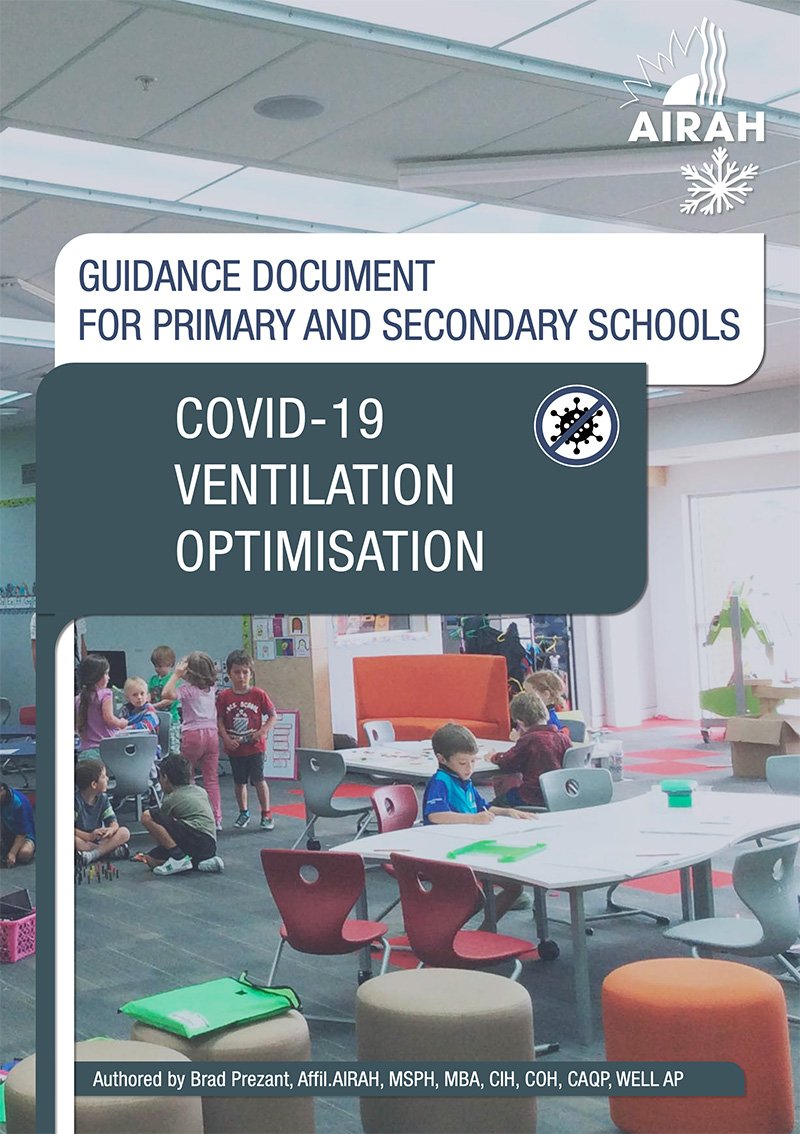
Guidance document: COVID-19 Ventilation Optimisation
Schools are a high-risk setting for spread of COVID-19, an airborne virus. School administrators and teachers are rightly concerned about the safety of children and staff.
Schools are being bombarded by vendors selling a myriad of products and services, some of which may improve the health of occupants, and some of which may increase the risk of infection. Many of the solutions offered are expensive.
This document, written from an evidence-based public health perspective, and published by Australia's leading engineering professional society for ventilation and air quality, is intended to address the many questions that school administrators have about how to create a school setting that is as safe as possible and where the focus can be on education, and not the building itself.
Recognition, Evaluation, and Control of Indoor Mold
A comprehensive peer-reviewed resource accepted throughout the world as a professional standard of care

Are we underestimating the potential for low-level asbestos exposures to cause disease

Brookhaven National Laboratory Tracer study
Hood effectiveness and entrainment of subsurface air: Impact on IAQ in a Seattle hospital

Calculating the burden of disease attributable to indoor dampness in New Zealand

Key outcomes from the AIRAH workshop on voluntary or mandatory IAQ requirements based on measurements of CO₂
Chaired by Bradley Prezant on behalf of AIRAH
On May 25, 2025, preceding the IAQ Conference in Melbourne, AIRAH convened a half-day workshop to address a critical topic: Is 800ppm CO₂ a good threshold value for ensuring adequate indoor air quality, or not?
Experts in the field addressing current regulations, practical applications, and the latest research shaping ventilation policies included Professors Max Sherman, Pawel Wargocki, Lidia Morawska, and Andrew Persily. Sonia Holzheimer from AIRAH and Jack Noonan from WELL Building Standard joined the speakers for a panel discussion moderated by Mr. Prezant. The summary of the workshop can be accessed below.
Clean Air Spaces Prototype Guidance Project - NSW Department of Climate Change, Energy, the Environment, and Water
Technical Review — ASHRAE Guideline 44: Protecting Building Occupants from Smoke During Wildfire and Prescribed Burn Events
authored by Bradley Prezant on behalf of AIRAH
This document provides a framework for assessing the applicability of ASHRAE Guideline 44 to NSW Buildings.
Taking the opportunity to reduce overall dose by lowering exposure levels in non-residential buildings can offer a significant contribution to lowering the overall burden of disease.
•It will be easier to implement changes to the building envelope and ventilation system in the design of new buildings; retrofitting existing buildings will be more difficult. This is especially true of historic buildings where options may be limited to zonal pressure controls. A trial of currently available options for these buildings would be useful to implement.

Design & Construction of a Multiple chamber remote activated bag sampler (RAGS) for measurement of peak concentration of indoor air contaminants
CV and biographical info
Prezant CV August 2026
Detailing employment, certifications, awards, presentations, published papers, organised conferences, book chapters, and other documents on occupational hygiene, ventilation, ergonomics, and indoor air quality
Prezant brief bio 2024
Brief biography of professional activities
Videos
IAQ Radio: Bradley Prezant, MBA - Assessing Risk of Infection & Air Exchange - CO2 Pitfalls, SF6 Benefits
ISIAQ - International Society: Airborne Transmission of COVID-19, Interview with Professor Morawska
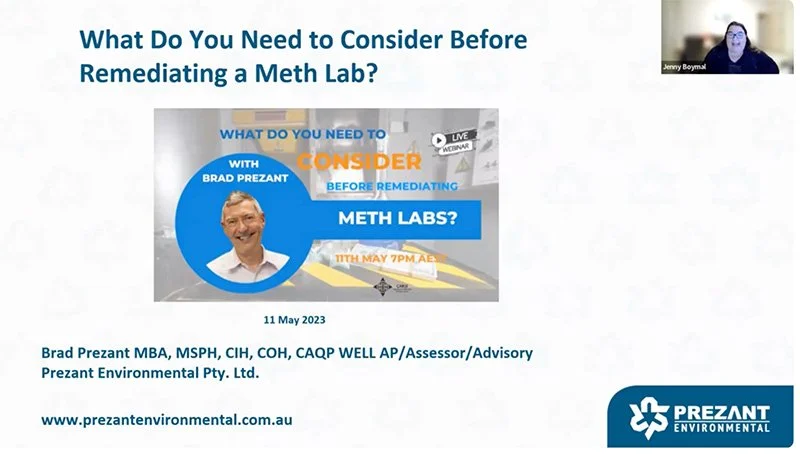
Presentation for CARSI by Brad Prezant of Prezant Environmental: What do you need to consider before remediating Meth Labs?
IAQ Radio: Bradley Prezant, MSPH, CIH, CPE - What is COVID-19 Infection Risk Manager?